# Stack overflowing on simple task
**URL:** https://forum.ada-lang.io/t/stack-overflowing-on-simple-task/4763
**Category:** General
**Tags:** embedded-stm32f429di
**Created:** [September 22, 2026, 7:46am UTC](https://forum.ada-lang.io/t/stack-overflowing-on-simple-task/4763 "2026-09-22T07:46:59Z")
**Posts on this page:** 7
**Page:** 1
### Author:  [@sidisyom](https://forum.ada-lang.io/u/sidisyom)
#### Post date: [September 22, 2026, 7:46am UTC](https://forum.ada-lang.io/t/stack-overflowing-on-simple-task/4763/1 "2026-09-22T07:46:59Z")
Hello,
I’ve come across a stack overflow issue with a debug version of the `embedded-stm32f429disco` runtime and I am trying to understand if I’ve got a corrupt memory on my board or there is something else going on.
Consider the following simple task spec and body (which doesn’t actually do anything useful):
```ada
with System;
package usart_tasks2 is
task type Test_Type with Priority => System.Max_Priority;
TT : Test_Type;
end usart_tasks2;
```
```ada
package body usart_tasks2 is
task body Test_Type is
M_A : Integer := 0;
begin
loop
M_A := (M_A + 1) rem 100;
end loop;
end Test_Type;
end usart_tasks2;
```
Now running this on an actual board traps immediately and after a bit of tracing in gdb I’ve come to the conclusion that the elaboration of the above task is causing the overflow.
Below are some screenshots of the tracing (please, keep in mind I am compiling with `-fstack-check`):
Starting from `start-rom.s` I put a breakpoint in `adainit` right before the elaboration is run:
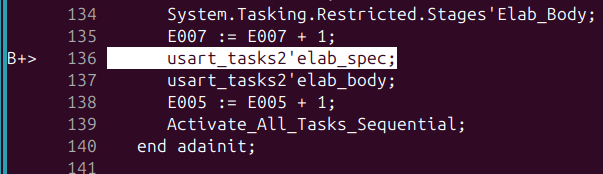
and then I put another one in `Stack-Check` whose call I believe is put in place by the compiler due to `-fstack-check`:
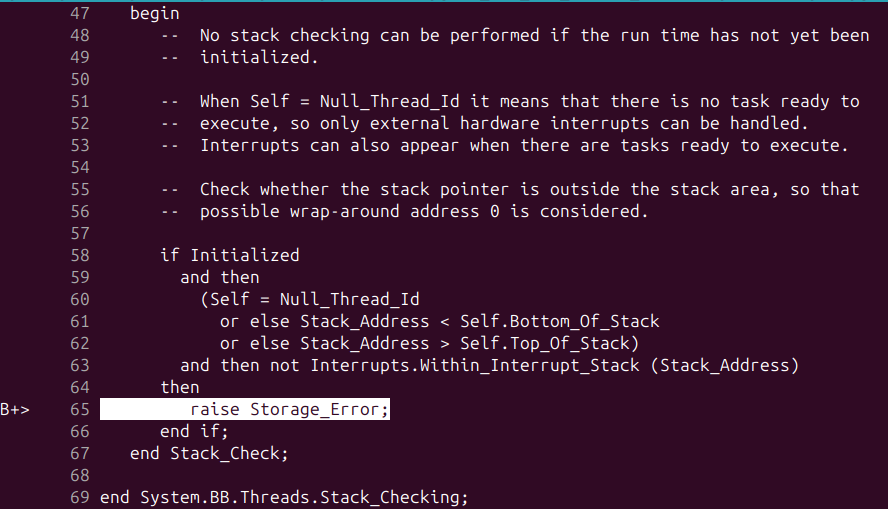
so it’s clear that the elaboration code is somehow overshooting the stack.
The actual address values can be seen below:
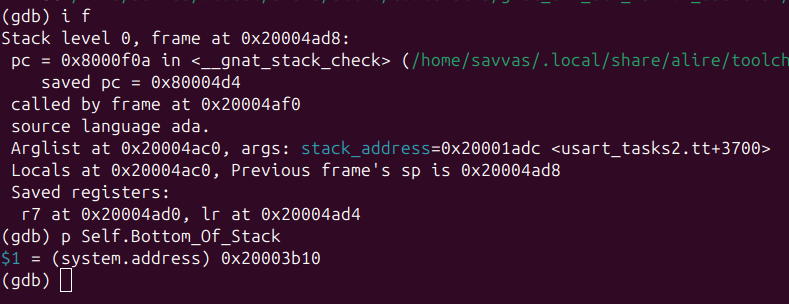
where clearly `stack_address` (in the printed Arglist) is way below `Bottom_Of_Stack` (cortex m4s are (full) descending).
I’m not entirely sure how stack boundaries _per-task_ are calculated but I assume each task is given a starting stack address and a (configurable) size and that `Bottom_Of_Stack` refers to the overall stack boundary calculated in the linker script? I.e. `__stack_start` here:

Any ideas what might be causing this? The only things declared are a `main` and the above task package where there are no complex declarations in the elaboration section. Could that be some memory corruption issue? 🤔
Thanks!
---
### Author:  [@sidisyom](https://forum.ada-lang.io/u/sidisyom)
#### Post date: [September 22, 2026, 7:57am UTC](https://forum.ada-lang.io/t/stack-overflowing-on-simple-task/4763/2 "2026-09-22T07:57:36Z")
..come to think of it now it’s the elaboration of the _spec_ that’s failing so I’m wondering if declaring a task object in the spec is somehow causing this 🤔
---
### Author:  [@Max](https://forum.ada-lang.io/u/Max)
#### Post date: [September 22, 2026, 8:25am UTC](https://forum.ada-lang.io/t/stack-overflowing-on-simple-task/4763/3 "2026-09-22T08:25:21Z")
Switch `-fstack-check` works a bit weird on embedded targets as for me: it checks 4k free space in stack. My advice - don’t use it, or replace Stack\_Check routine by custom implementation.
See [How to protect from stack overflow on embedded targets?](https://forum.ada-lang.io/t/how-to-protect-from-stack-overflow-on-embedded-targets/4331)
---
### Author:  [@damaki](https://forum.ada-lang.io/u/damaki)
#### Post date: [September 22, 2026, 8:38am UTC](https://forum.ada-lang.io/t/stack-overflowing-on-simple-task/4763/4 "2026-09-22T08:38:19Z")
> [@sidisyom](#):
>
> where clearly `stack_address` (in the printed Arglist) is way below `Bottom_Of_Stack` (cortex m4s are (full) descending).
I think these are referring to two different stacks. `stack_address` in the Arglist is referring to the stack for `TT`, but `Bottom_Of_Stack` is referring to the caller’s stack (the environment task I believe), so the stacks for `TT` and the environment task would be expected to not overlap.
Note that ` __stack_start` and `__ stack_end` in the linker script marks the area used for the environment task’s stack. Stacks for `task`s are allocated in `.bss` as far as I understand.
> [@Max](#):
>
> Switch `-fstack-check` works a bit weird on embedded targets as for me: it checks 4k free space in stack.
Yes, the additional 4k is because the stack check needs to make sure that there is sufficient stack space available to be able to safely raise and propagate a `Storage_Error` if the stack check fails. If the stack check only checked that only the current stack frame is within the limit, then it may not have enough space on top of that to be able to raise and propagate the `Storage_Error`, which would result in a stack overflow anyway.
So to me it sounds like the environment task’s default stack size (4 kB) is too small for `-fstack-check` which requires additional overhead mentioned above, so you probably need to increase it when you have stack checking enabled. You can increase it by defining a value for `__stack_size` in your linker switches. For example, by adding this to your project’s GPR file to set it to 8 kB:
```ada
package Linker is
for Switches ("Ada") use ("-Wl,--defsym=__stack_size=8192");
end Linker;
```
---
### Author:  [@sidisyom](https://forum.ada-lang.io/u/sidisyom)
#### Post date: [September 22, 2026, 7:20pm UTC](https://forum.ada-lang.io/t/stack-overflowing-on-simple-task/4763/5 "2026-09-22T19:20:27Z")
> [@damaki](#):
>
> I think these are referring to two different stacks. `stack_address` in the Arglist is referring to the stack for `TT`, but `Bottom_Of_Stack` is referring to the caller’s stack (the environment task I believe), so the stacks for `TT` and the environment task would be expected to not overlap.
Right, I see..so it sounds like the flag requires that there’s _at least_ 4K of free space after `Bottom_Of_Stack` to do the propagation (so probably the real stack end for the caller stack is `Bottom_Of_Stack` - 4K 🤔)
> [@damaki](#):
>
> Note that ` __stack_start` and `__ stack_end` in the linker script marks the area used for the environment task’s stack. Stacks for `task`s are allocated in `.bss` as far as I understand.
Good to know, I was under the impression these marked the entire available space for everything and then the runtime chopped it up based on the consumer entities. Can also see in the linker script there are ` __interrupt_stack_start` & `__ interrupt_stack_end` too which come right after `__bss_end = .;` so it looks like interrupt handlers get their own range too.
> [@damaki](#):
>
> If the stack check only checked that only the current stack frame is within the limit, then it may not have enough space on top of that to be able to raise and propagate the `Storage_Error`, which would result in a stack overflow anyway.
Yeah, that’s what I observed in gdb too as the raised exception hits the `__gnat_last_chance_handler` which tries to do some printing in semihosting and that generates a range of frames with each one declaring various objects etc so guaranteeing the extra space definitely makes sense. Would be curious to know how the runtime actually propagates that exception and calls the last chance if only local handling is allowed in this profile?
> [@damaki](#):
>
> For example, by adding this to your project’s GPR file to set it to 8 kB:
That’s really cool to know, however in my setup it doesn’t seem to take effect as I am getting the same issue. Removing the flag alltogether as suggested by Max seems to fix that.
Many thanks for all the input folks!
---
### Author:  [@damaki](https://forum.ada-lang.io/u/damaki)
#### Post date: [September 22, 2026, 9:24pm UTC](https://forum.ada-lang.io/t/stack-overflowing-on-simple-task/4763/6 "2026-09-22T21:24:14Z")
> [@sidisyom](#):
>
> Would be curious to know how the runtime actually propagates that exception and calls the last chance if only local handling is allowed in this profile?
A `Storage_Error` from a stack check failure can’t be handled locally unfortunately in this case. So when exception propagation is disabled (i.e. when the `No_Exception_Propagation` restriction is in effect, as it is for “light” and “light-tasking” runtime profiles), then the last chance handler is called immediately when the `Storage_Error` exception is raised.
---
### Author:  [@system](https://forum.ada-lang.io/u/system)
#### Post date: [September 24, 2026, 9:24pm UTC](https://forum.ada-lang.io/t/stack-overflowing-on-simple-task/4763/7 "2026-09-24T21:24:36Z")
This topic was automatically closed 2 days after the last reply. New replies are no longer allowed.