The recording is here:
Previous recordings: https://www.youtube.com/playlist?list=PLUyHH211jYhg
Chat messages:
00:35:16.836,00:35:19.836
Fernando Oleo: Would also love to see it here https://github.com/enjoy-digital/litex


00:46:46.294,00:46:49.294
Cesar Sagaert: Many Flare features are described in the https://github.com/AdaCore/ada-spark-rfcs/ repo
Transcript:
Summary
Project updates highlighted AutoSAR rewrites and Freya FPGA board specifications and Flare language extensions for Ada.
AutoSAR Spark Project Update
AI driven conversion rewrites 25000 lines of C code into Spark to eliminate buffer overruns. Project completion is targeted by the end of the weekend on hardware.
Freya FPGA Board Architecture
New open source Freya board utilizes Ada and Spark with extensive memory specifications and connectivity options. Technical feedback suggested evaluating Crowdsupply for manufacturing batches.
Flare Language Extensions Ada
Flare initiative provides modern language extensions for Ada to lower entry barriers with selective enablement. Gnat Commons compiler will synchronize openly with commercial releases.
Details
Attendee 2’s AutoSAR Spark Project Update: Attendee 2 discusses an ongoing AI-driven project to convert an AutoSAR hardware abstraction layer implementation into Spark to eliminate buffer overruns and undefined behavior. The project involves rewriting approximately 25,000 lines of C code, updating system requirements, and running on an STMicroelectronics micro board with CAN bus connectivity, with full project completion targeted by the end of the weekend.
Community Events and Conference Submissions: Attendee 2 provides updates on upcoming community events and conference presentations, noting that an application for an Ada dev room at FOSDEM was unsuccessful, which led to a community application for a stand instead, alongside an individual submission to the open-source system programming languages dev room. Additional presentations are scheduled or submitted for the Embedded Systems Conference in San Jose in January by Attendee 1, the Embedded Online Conference, and the upcoming Ada Europe event in Berlin in June. Furthermore, an Ottawa community meetup is scheduled for November 25th with approximately 12 people signed up.
Introduction of the Freya Open FPGA Board: Attendee 1 introduces “Freya,” a new open-source FPGA board built around Ada, Spark, and Ali to eliminate setup friction and reliance on closed proprietary hardware, utilizing a public repository approach with KeyCAD designs and a 2.54mm pin standard. The board is powered by an Artix-7 FPGA featuring 100K logic cells and is controlled by a Raspberry Pi Pico 2 board controller (RP2350) running a native Ada firmware via USB-C for board health monitoring, power control, and FPGA programming.
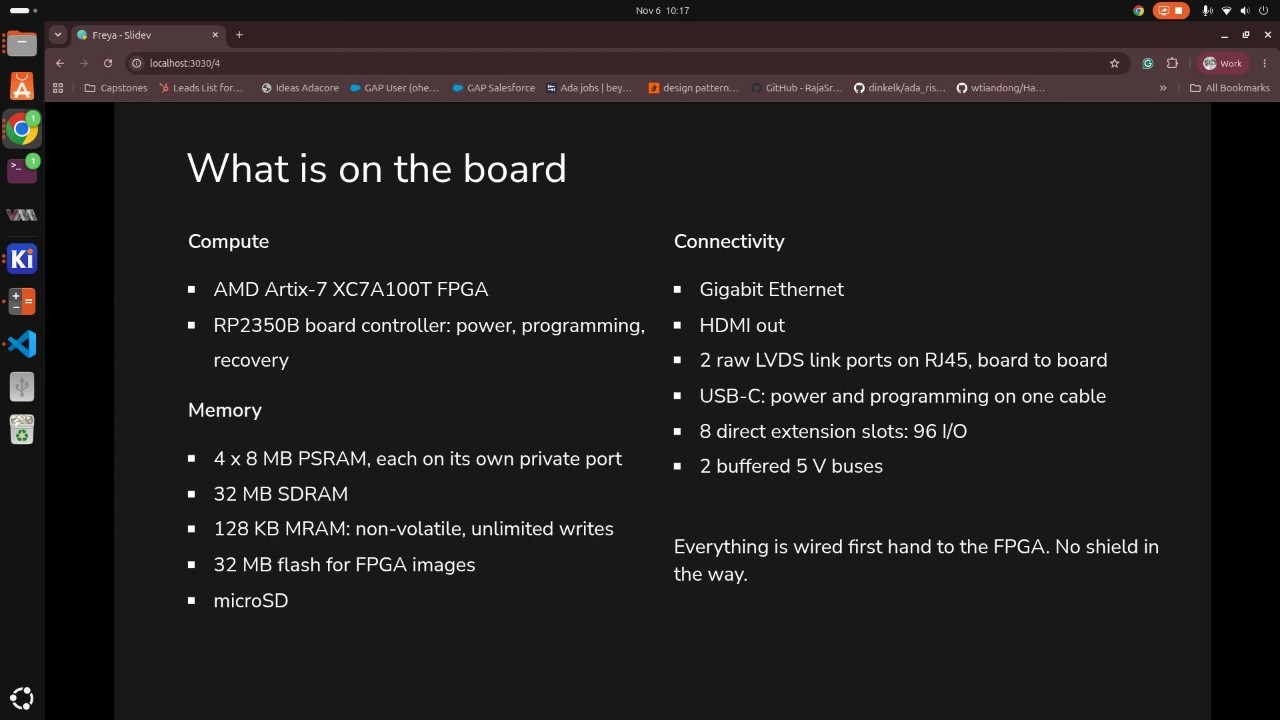
Freya Board Technical Memory Specifications: Attendee 1 details the memory architecture of the Freya board, which includes four 8-megabyte pseudo-static RAM (PSRAM) ports for uniform read and write latency, 32 megabytes of SDRAM for frame buffers, 128 megabytes of magnetoresistive RAM (MRAM) for persistent data storage across power resets, 32 megabytes of flash memory for FPGA images, and a microSD card slot.
Freya Board Connectivity and Extension Architecture: Attendee 1 outlines the connectivity features of the Freya board, including gigabit Ethernet, HDMI output, two raw LVDS link ports on RJ45 connectors, and eight extension slots supporting up to 96 input/output pins and two buffered 5-volt logic buses. The power system relies on a conservative 27-watt USB-C power delivery rail alongside a secondary auxiliary “suicide” rail to support industrial or variable power requirements with short-circuit isolation protecting the core components.
Feedback and Recommendations on the Freya FPGA Board: Attendee 7 and Attendee 6 provide technical feedback and suggestions for the Freya board, recommending the addition of a second USB port, evaluating Crowdsupply for manufacturing distribution of production batches around 100 to 200 units, increasing RAM to 64 megabytes if full Linux support is desired, and specifying audio CD-quality digital-to-analog converter requirements. Attendee 1 notes that the board primarily targets Ada, Spark, and Zephyr deployments rather than heavy Linux environments, while confirming support for standard digital buses and the New RV32 RISC-V soft core.
Freya Board Soft Core and Peripheral Integration: Attendee 1 explains that the Freya board utilizes the New RV32 RISC-V soft core, for which they provide runtime support, light tasking, and basic peripheral board support packages for universal asynchronous receiver-transmitters, general-purpose input/outputs, and serial peripheral interfaces, while noting that managing esoteric extension drivers remains an open structural question.
Introduction of Flare Language Extensions for Ada: Attendee 2 introduces “Flare,” a multi-year initiative providing modern language extensions for Ada—starting with version 0.1 and object-oriented programming changes partially implemented in GNAT Pro 27—designed to lower the barrier of entry for new programmers by incorporating modern object orientation and constructor semantics. The extensions can be enabled selectively at the compilation unit level using pragmas or command-line switches to maintain backward compatibility with existing codebases.
GNAT Commons Compiler Synchronization and C++ Compatibility: Attendee 2 and Attendee 1 clarify that Flare is not intended to serve as a complete C++ clone or replicate complex C++ template patterns, but rather to evolve Ada in alignment with its core traditions while borrowing practical features from other modern languages. Additionally, Attendee 2 announces that a new open-source “GNAT Commons” compiler will be released in direct lock-step with GNAT Pro commercial releases to facilitate community contributions and version synchronization.