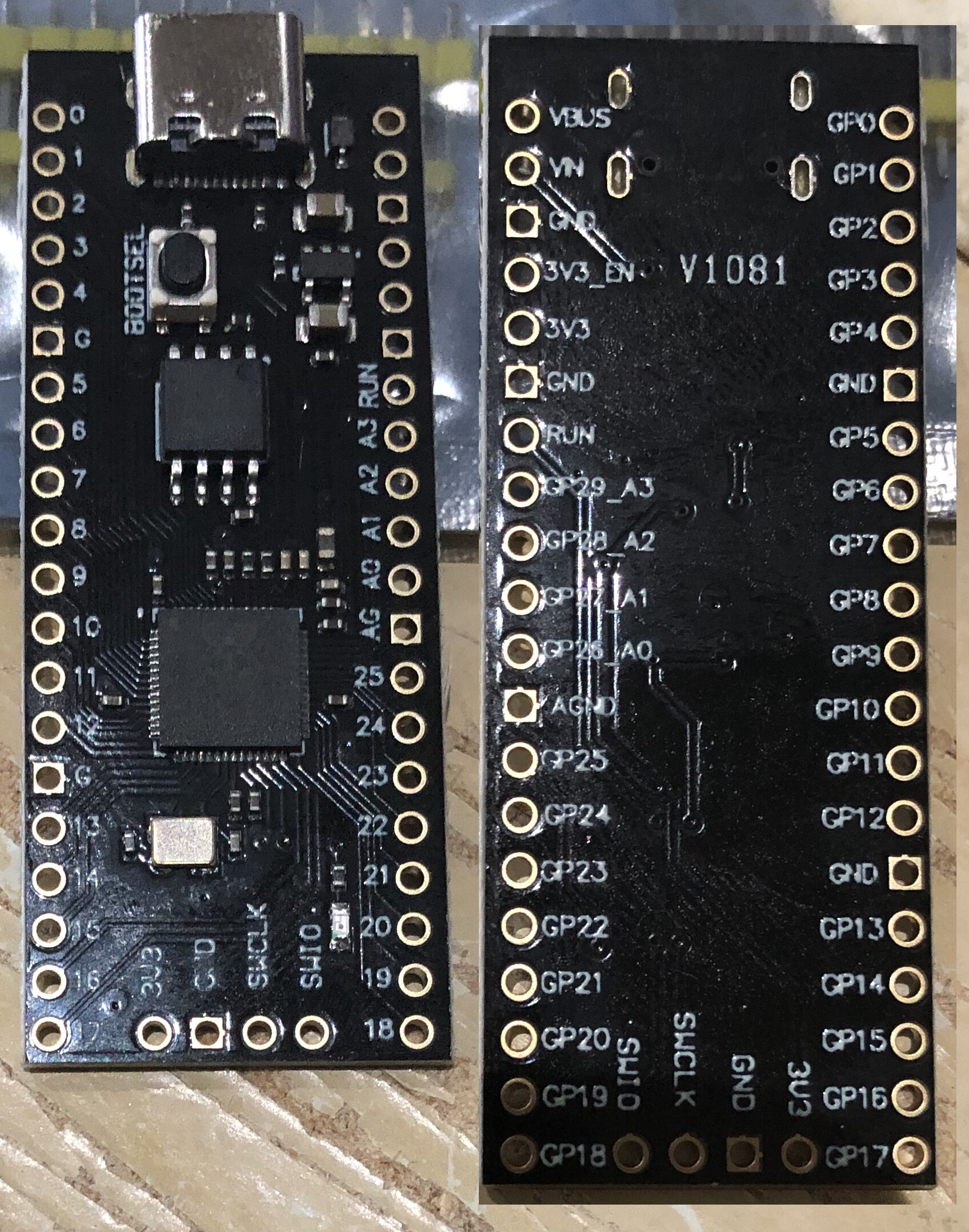
I bought an el cheapo rp2040 pico board (probably a clone) from ali (16MB variant is probably overkill) because it was cheap.
I dug out the parts of a broken Kawai ES110 I bought to see if i could find out what’s wrong with it, but no luck so far, the plan was always to bolt on a Linux SBC and try to turn it into something useable as I can’t afford a replacement main board right now.
But I thought I’d start with this rp2040 as it’s here and useable. But what do I need from Alire?
The intention is to use the ES’ main panel (JST B13B-PH-K) the IO board for the MIDI out (only - via a JST B7B-PH-K pin) and the keybed for input (JST B15B-PASK-1). Need 28 pins at most.
And I’ve just realised they sent the wrong board, they sent me the lite version and I cannot find a pin out for that bar what’s on the back, nor any docs about what a “lite” version is, yes a refund is happeningm, don’t know if I need to send this back and whether I can even use it now.
Regarding runtimes for the RP2040, the choice depends on how much language support you want. If you just want a “light” runtime (no tasking, minimal heap support, no exception propagation etc) then you can just use the rp2040_hal crate. You can check out Jeremy’s blink example as an example app that uses a light runtime.
If you want more language support for things like Ada tasks (across both cores), protected objects, exception propagation, or a full heap allocator, then you can use either the light_tasking_rp2040 or embedded_rp2040 crates. I have an example of using these runtimes to run tasks on both cores in my pico_smp_demo repo.
I assume that this clone is meant to have the same flash chip as the genuine Pico (or at least one that is drop-in compatible with it) in which case you don’t need to worry about it. If the flash chip is not compatible, however, then you may need to tweak the crate configuration to make sure they use a compatible flash driver so that the QSPI is correctly configured.
From a quick look at the datasheet it appears compatible with the equivalent Winbond part, so you shouldn’t need to change anything. You should be able to build the pico_smp_demo project I linked above and it should run and blink the LED on the board (assuming the LED is on the same GPIO as the Pico, which it probably is).
I get continuity with the tiny resistor I need a billion times magnification on to see and pin labeled “25” and the moving the probe up one to “AG” lights up the LED.
Yup, the blink demo works, had to install elf2uf2-rs to get it converted with cargo, both uf2-util and pico-uf2 didn’t work for me because I didn’t know what to do with them.
You can have multiple tasks on both cores. The runtime will take care of context switching between them on each core based on their priority in the usual manner.
Ok, created my own BSP which is basically a set of renamings for the GP? pins and adding GP29. I’ve created a blink demo which used GP0 and GP29 and both work.