I was reading the Guide for the use of the Ada Ravenscar Profile in high integrity systems, in particular the specification of Activation_Manager package at page 67.
with Ada.Real_Time;

package Activation_Manager is

 use Ada.Real_Time;

 function Clock return Ada.Real_Time.Time renames Ada.Real_Time.Clock;

 -- global start time relative to which all periodic events
 -- in system will be scheduled
 System_Start_Time : Ada.Real_Time.Time : constant := Clock;

 -- relative offset of task activation after elaboration (milliseconds)
 Relative_Offset : constant Natural := 100;

 Task_Start_Time : constant Ada.Real_Time.Time_Span :=
 Ada.Real_Time.Milliseconds(Relative_Offset);

 -- absolute time for synchronization of task activation after elaboration
 Activation_Time : constant Ada.Real_Time.Time :=
System_Start_Time + Task_Start_Time;

 procedure Activation_Sporadic;

 procedure Activation_Cyclic
 (Next_Time : out Ada.Real_Time.Time);

end Activation_Manager;
In order to avoid any access-before-elaboration (ABE) error, shouldn’t be the case to control the elaboration of Ada.Real_Time body using pragma Elaborate (Ada.Real_Time);? In this way, the previous spec should be:
with Ada.Real_Time;
pragma Elaborate (Ada.Real_Time);

package Activation_Manager is

 use Ada.Real_Time;

 function Clock return Ada.Real_Time.Time renames Ada.Real_Time.Clock;

 -- global start time relative to which all periodic events
 -- in system will be scheduled
 System_Start_Time : Ada.Real_Time.Time : constant := Clock;

 ... and so on ...

end Activation_Manager;
I think that pragma is needed since the use of Clock function belonging to Ada.Real_Time package. It looks like the scenario described here:
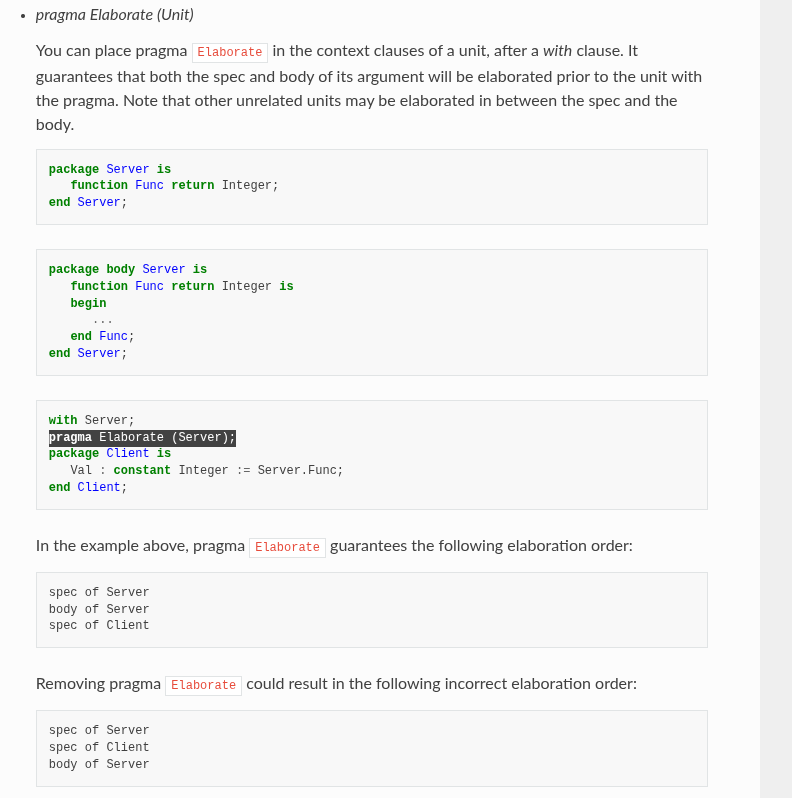
Isn’t it? Is this different because we’re talking about a dependency on a runtime package rather than an application one?