FOSDEM 2027: 30 & 31st of January

Dear all,

FOSDEM has published their dates for the next edition! FOSDEM 2027 It is also interesting to see that they have changed their website quite a lot!

We will again try to be there with a Devroom or at least a stand! Hopefully in the next few days I will get the submission texts we usually do and share them with you the community so that you can propose improvements! Additionally for this edition, if we get a devroom, @markhermeling will hopefully be with us!

Best regards and talk to you soon,
Fer

EDIT: PS, pinging @DirkCraeynest, @Fabien.C and @ohenley just in case
EDIT 2: I will go regardless of the outcome of the Ada presence there, so if you go, you can say hi and buy me a beer (joke)!

12 Likes

Thanks for the notification, Fer!

I’ve forwarded your message to the AdaFOSDEM mailing list, so the people there are informed as well… http://listserv.cc.kuleuven.be/archives/adafosdem.html

4 Likes

Hi,

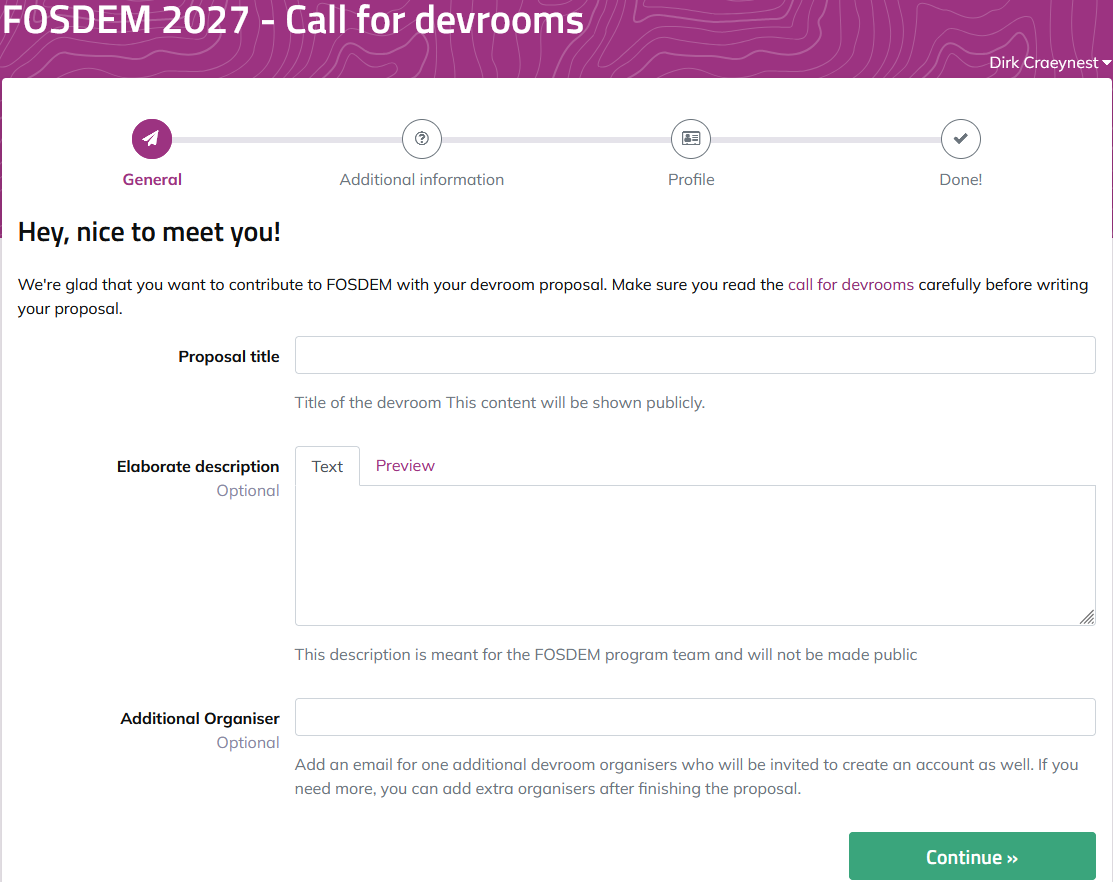
I would like to post the content of our proposal to FOSDEM that we usually send in case anybody would like to make it better and increase our chances of getting accepted.

Information that is required by the FOSDEM organization

(The following “sections” mirror the submission form of the FOSDEM system, this one is from 2025)

— Notes ----------------------------------------------------------------------

[[Note: Preferred slot: Full day (Saturday). If it is not available, 2nd best option: half day (Saturday afternoon).]]

Ada is a general-purpose programming language originally designed for embedded
and mission-critical software engineering, although nowadays it also supports
object orientation, contracts and formal verification. It is used extensively in
air traffic control, rail transportation, aerospace, nuclear, financial
services, medical devices, etc. It is also perfectly suited for open source
development with a fully open compiler (part of GCC), formal verification system
and a knowledgeable and vibrant community.

Awareness of safety and security issues in software systems is increasing. The
NSA recently published [1] a list of programming languages that are recommended
for the development of new software due to their memory safety and Ada was one
of the list (one of the three compiled non-garbage collected languages!). In
that context, it should be no surprise that NVIDIA has started using Ada/SPARK
[2, 3] for their highest critical parts in their GPUs! The forums [4] have also
seen an uptick of new users since the NSA announcement.

Multi-core platforms are now abundant and small, embedded devices are growing
exponentially. These are some of the reasons that the Ada programming language
and technology attracts more and more attention due to Ada’s support for
programming by contract, performant and efficient code, high- and low-level
abstractions and support for multi-core targets. The latest Ada language
definition, Ada 2022, was approved by ISO as an international standard last
year. Work on implementing the new features is ongoing, such as improved support
for fine-grained parallelism, which were introduced in the new standard. The
Ada-related technology, SPARK, provides a complete solution for the safety and
security aspects stated above while being fully open source, making it stand out
from other formal verification tools, as Ada/SPARK code is compiled directly
into ready-to-run programs, which can even run on embedded systems.

More and more tools are available, many are open source, including for small and
modern platforms. Interest in Ada keeps increasing, also in the open source
community, and many exciting projects have been created with Ada.

[1] https://www.nsa.gov/Press-Room/News-Highlights/Article/Article/3215760/nsa-releases-guidance-on-how-to-protect-against-software-memory-safety-issues/
[2] https://www.adacore.com/papers/nvidia-adoption-of-spark-new-era-in-security-critical-software-development
[3] When Formal Verification with SPARK is the Strongest Link | AdaCore
[4] https://forum.ada-lang.io/

— Preferred slot -------------------------------------------------------------

Saturday

— Why does this proposal fit FOSDEM ------------------------------------------

The Ada devroom aims to facilitate a space for Ada and non-Ada programmers to
learn and share the features offered by the Ada language (such as for
object-oriented, multicore, formal verification or embedded programming) as well
as some of the many exciting tools and projects using Ada.

Ada is one of the languages supported by GCC with a focus on correctness,
maintainability and easy of use. It also comes with a sister language, SPARK,
which focuses on formal proofs and analysis. These topics are becoming more
relevant as time passes. Which is why a lot of new languages, such as Rust or
Zig, have been created and try to improve the state of software development.

The tooling around Ada is open and has seen a great deal of development in the
past few years. Developers have also been creating new programs with it and
FOSDEM would be a wonderful choice for them to present and share their
work. FOSDEM is also useful both as a meeting opportunity for the Ada community
to come together and share their passion among fellow users, as well as for
curious viewers who may want to learn more about the Ada language and ecosystem.

— Submitters affinity to the topic -------------------------------------------

I (Fernando) first attended FOSDEM with a presentation in 2021 (A (very) quick
overview of libre mechanical software).

I then succeeded Dirk Craeynest as the coordinator for the Ada devroom in FOSDEM
2022 as I had fallen in love with Ada the years prior. It was my first year as a
coordinator and I would like to continue as such. In FOSDEM 2023, as the Ada
devroom was not chosen, I helped organise the Ada stand, called “It’s time to
learn Ada!”, with the help of Tama McGlinn. In 2024 we were also not chosen to
have a devroom. In the 2025 edition of FOSDEM I will be helped by Dirk
Craeynest, who was the coordinator of the Ada devroom in earlier years, and
A. J. Ianozi, a prolific Ada hacker and creator or GetAda, a Rustup-like tool
for Ada.

In terms of my personal involvement with Ada, I tend to focus mostly on
fostering a sustainable and healthy community. For example, in June 2024 I gave
a talk in the Ada Developers Workshop, which took place during the Ada-Europe
International Conference, about community advocacy. The slides can be found in
[1, 2] and the recording in [3]. Oh, and I was also the main organiser of the
Workshop! But my day to day life with Ada revolves around fixing bugs and
answering people in the forums [4] (my nick is Irvise).

[1] Ada-Europe 2024 - Ada Developers Workshop
[2] http://www.ada-europe.org/conference2024/presentations/Ada_Community_Advocacy.pdf
[3] https://www.youtube.com/watch?v=TAFlWVsLM-I
[4] https://forum.ada-lang.io/

— Relevant URLs --------------------------------------------------------------

FOSDEM 2019 Ada devroom FOSDEM 2019 - Ada devroom
FOSDEM 2020 Ada devroom FOSDEM 2020 - Ada devroom
FOSDEM 2022 Ada devroom FOSDEM 2022 - Ada devroom
Ada-Lang website https://ada-lang.io/
Ada-Lang forums https://forum.ada-lang.io
Personal profile of the forums Profile - Irvise - Ada Forum


Again, feedback is welcomed!
Best regards,
Fer

6 Likes

In the 2027 edition, I guess.

At the end of the “Notes” section we might want to add a paragraph on how it has been experienced that both Ada and SPARK work very well with AI to improve the correctness of the generated code. Plus maybe some rationale why that’s so…

2 Likes

Something along the lines of:
There is a renewed interest in Ada SPARK because the frontier artificial intelligence models are very good at generating code in Ada SPARK and are equally strong in generating the contracts needed for the formal methods engines. This increases the trust in the AI generated artifacts as the software developer can statically prove the absence of runtime errors and even prove functional correctness.
The combination of AI with Ada SPARK is lowering the barrier of entry for the use of formal methods in software engineering project.

2 Likes

Thanks for this text, Mark.

I propose a few small edits, to emphasize that both Ada itself and Ada SPARK to an even greater extent work very well with AI.


There is an increased interest in Ada and SPARK because the frontier artificial intelligence models are very good at generating code in Ada and are equally strong in generating the contracts in Ada SPARK needed for the formal methods engines. This increases the trust in the AI generated artifacts as the software developer can statically prove the absence of runtime errors and even prove functional correctness.

The combination of AI with Ada and SPARK is lowering the barrier of entry for the use of formal methods in software engineering projects.

The call has been made! FOSDEM 2027 Call for Devrooms — FOSDEM 2027

In order to maximize the likelihood of being accepted, I would recommend to indicate that our preference is a half day room. I know this is a controversial point, but I fear that we may fail to have a full schedule as we now have the Ada Developers Room during AEiC and having a half day may increase our chances of having a room…

@markhermeling, if we do not get accepted, the proposal you sent via email may be very interesting for the AI room, so consider that just in case (I am assuming there will be an AI room as in the past few years). Also, there are usually people/managers from Zephyr and other interesting projects such as ELISA https://elisa.tech/

Changes to our CfP

I agree that we should include AI to the mix. It is a hot topic, Ada/SPARK excels at it and some people, who dislike AI, may be drawn to the possibility of using it with more guardrails.

Additionally, I think our CfP is… not optimal. Maybe we could simplify it a bit and make it shorter. Sometimes shorter reads are more appealing as they need to be “punchier” :slight_smile:

I will try to create a simplified proposal (with AI) later today. However, in case I cannot, I am going to be away for the next week, so I wont be available to do so.

Best regards,
Fer

1 Like

Description

Ada is a general-purpose programming language originally designed for embedded
and mission-critical software engineering, although nowadays it also supports
object orientation, some functional goodies, contracts and formal verification. It is used extensively in
air traffic control, rail transportation, aerospace, nuclear, financial
services, medical devices, etc. It is also perfectly suited for open source
development with a fully open compiler (part of GCC), formal verification system (GNATprove)
and a knowledgeable and vibrant community.

Awareness of safety and security issues in software systems is increasing. The
NSA recently published [1] a list of programming languages that are recommended
for the development of new software due to their memory safety and Ada was one
of the list (one of the three compiled non-garbage collected languages!). In
that context, it should be no surprise that NVIDIA has started using Ada/SPARK
[2, 3] for their highest critical parts in their GPUs! Additionally, with the new wave of AI and LLM tools and code generation, Ada/SPARK seats at a privileged spot as AIs can write code that is fully verified and can target all kinds of problem domains, from embedded systems all the way to web with WebAssembly. The forums [4] have also
seen an uptick of new users since the NSA announcement.

Multi-core platforms are now abundant and small, embedded devices are growing
exponentially. These are some of the reasons that the Ada programming language
and technology attracts more and more attention due to Ada’s support for
programming by contract, performant and efficient code, high- and low-level
abstractions and support for multi-core targets. The latest Ada language
definition, Ada 2022, was approved by ISO as an international standard last
year
recently. Work on implementing the new features is ongoing, such as improved support
for fine-grained parallelism, which were introduced in the new standard.
The
Ada-related technology, SPARK, provides a complete solution for the safety and
security aspects stated above while being fully open source, making it stand out
from other formal verification tools, as Ada/SPARK code is compiled directly
into ready-to-run programs, which can even run on embedded systems.

More and more tools are available, many are open source, including for small and
modern platforms. Interest in Ada keeps increasing, also in the open source
community, and many exciting projects have been created with Ada.

[1] https://www.nsa.gov/Press-Room/News-Highlights/Article/Article/3215760/nsa-releases-guidance-on-how-to-protect-against-software-memory-safety-issues/
[2] https://www.adacore.com/papers/nvidia-adoption-of-spark-new-era-in-security-critical-software-development
[3] When Formal Verification with SPARK is the Strongest Link | AdaCore
[4] https://forum.ada-lang.io/

Why does this proposal fit FOSDEM

The Ada devroom aims to facilitate a space for Ada and non-Ada programmers to
learn and share the features offered by the Ada language (such as for
object-oriented, multicore, formal verification or embedded programming) as well
as some of the many exciting tools and projects using Ada.

Ada is one of the languages supported by GCC with a focus on correctness,
maintainability and easy of use. It also comes with a sister language, SPARK,
which focuses on formal proofs and analysis. These topics are becoming more
relevant as time passes. Which is why a lot of new languages, such as Rust or
Zig, have been created and try to improve the state of software development.

The tooling around Ada is open and has seen a great deal of development in the
past few years. Developers have also been creating new programs with it and
FOSDEM would be a wonderful choice for them to present and share their
work. FOSDEM is also useful both as a meeting opportunity for the Ada community
to come together and share their passion among fellow users, as well as for
curious viewers who may want to learn more about the Ada language and ecosystem.

Submitters affinity to the topic

Add/Change sections depending on whether Mark, AJ, Fabien, etc are available

PS: I did not use the proposed AI paragraph as I felt it could be shorter and sweeter the way I wrote it. Nevertheless, I did it in a rushed manner and feedback, changes or anything in between is welcomed.

Best regards,
Fer

2 Likes

This looks good Fer.

I like the idea of doing a half day. And yes, I will be in attendance, so feel free to mention my name in the application.

1 Like

Except it was “originally designed” as a general purpose language to replace thousands of other languages whose areas included real time embedded.

The above statement just continues the false narrative that Ada is for embedded only.

It is indeed important to state that Ada is a general-purpose language, and a very successful one. We should not overstress the embedded use, otherwise people who are not into embedded work lose interest immediately. I’ve had to fight that misconception on multiple occasions.

3 Likes

This is an acceptable note but I think I can offer some sensible advice (I’m a terminally literary man).
My focus is on smooth and logical flow of text.

Let’s start with the Description (all I had time to go through right now):

Original:

Ada is a general-purpose programming language originally designed for embedded
and mission-critical software engineering, although nowadays it also supports object orientation, some functional goodies, contracts and formal verification.
It is used extensively in air traffic control, rail transportation, aerospace, nuclear, financial services, medical devices, etc.
It is also perfectly suited for open source development with a fully open compiler (part of GCC), formal verification system (GNATprove) and a knowledgeable and vibrant community.

Edited:

Ada is a general-purpose programming language designed for efficient and methodical software engineering.
In addition to common capabilities found in other languages, Ada supports contracts, built-in concurrency and parallelism, and has tools for formal verification.
The language is particularly suited for development of real-time and high-integrity systems, such as those used in automotive, railway, aerospace, energy, finance, and healthcare industries.
It is also fit for open source development, with an open compiler (part of GCC), a package manager (Alire), and a helpful, knowledgeable community.

The first sentence is based on Jean Ichbiah interview from ACM [1]
The second sentence replaces nebulous terms (object orientation, functional goodies) with actual features which can rarely be found at comparable level of support elsewhere.
The third sentence is reformulation to make it more relative (“particularly suited” vs “used extensively”). The industries list is a mouthful, could be shortened by an item or two, and should be verified for accuracy.
The fourth sentence focuses on openess (the addition of Alire) and no hyperbole (“perfectly”, “vibrant”). I also remove the GNATprove part, because I don’t see it as intimately connected to open source development.

[1] https://dl.acm.org/doi/10.1145/358274.358278

4 Likes