Hah, wow, that’s amazing!! I didn’t expect someone to just grab this code and attempt to get it compiling of the bat, I love it! 
At first glance it seems that Andrii Kurdiumov hit one of the caveats that Jan van Katwijk mentioned to: “the Ada- compiler is itself probably needed to generate the tree representation for the Standard package”.
The reference to ada_cg is in the “standard” package in the repo and this package seems to contain a mapping from “standard” Ada types, procedures and functions to the ones that were implemented in DAS. DAS (Delft Ada Subset) was an earlier subset developed at Delft University. Some of the folks that worked on DAS also worked on Ada- and there was also some code reuse.
This standard package is a very tiny, albeit necessary, package to define basic types like integer and string and all the foundational operators that you will need. It maps those to the actual definitions in a C library from DAS.
I didn’t include a .gitignore on purpose, so all the previously object files and other compiler artifacts are all there. I really haven’t done a deep dive into the repo, but I suspect that the precompiled standard package can be found in the lib/std_ps.t file.
If we really want to make a serious effort in bringing this compiler back to life then work like Andrii did is incredibly valuable. It is a sort of nice and sweet quick sweep that allows us to quickly mark the “pain points” in doing a port to the 21st century.
A concerted effort would imo be a combination of these kind of best effort porting attempts, paired with a broader clean up and documentation effort so we have in debt knowledge on the workings of all bits and bobs.
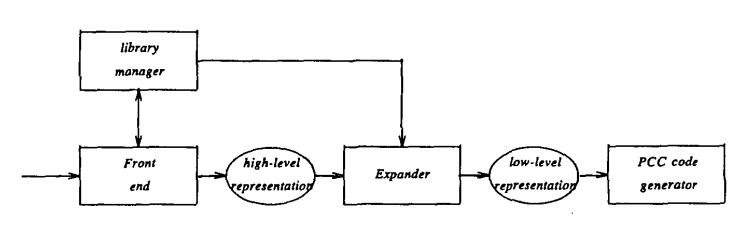
The system seems to be a collection of separate sub systems that are compilable on their own (UNIX-philosophy, I like it ;-). It relates in a very loose manner to the structure of this compiler described in the thesis:
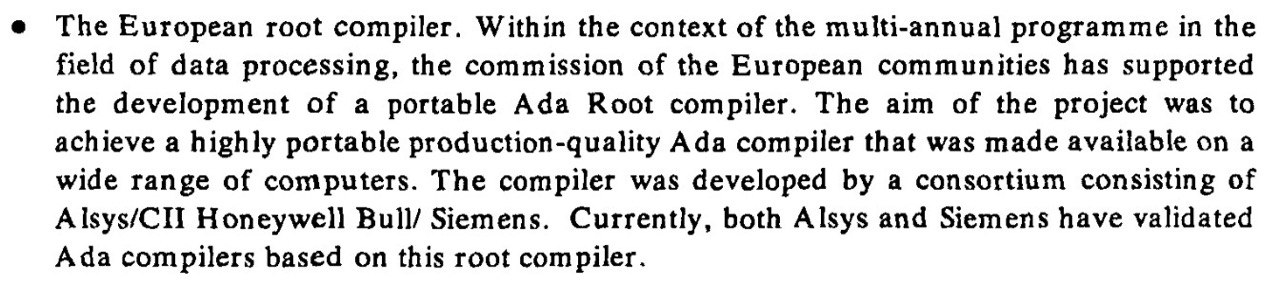
The structure of the frontend would be pretty recognizable to anyone who has done compiler dev in any unixy environment, with lex and yacc as the well-known regular guests  . The caveat here is that they use a pretty clever custom version of yacc. They didn’t choose to use DIANA for the high level representation, but their own rep. In my opinion this is a sensible choice. I probably wouldn’t use DIANA either if I built an Ada 83 compiler from scratch either. DIANA seems to be rooted firmly in the particular flavor of modularity that was very in vogue in the 80s. Anyone who’s nerding out on Ada’s 80s history might recognize this mindset from the “Ada Root compiler” initiative from those days.
There was a hope that if you could fence of particular parts then they could be used interchangeably. Really drinking the Unix Kool-aid, which I personally quite enjoy, but as with all things in moderation. The folks at Delft University realized this and a lot of code in this project has that nice old school C enthusiast hacker quality to it which I still very much enjoy in the BSD’s for example.
Anyway, I’m not yet sure I want to revive this compiler completely. Right now I’m mostly looking into it from a historic enthusiast perspective and really enjoying the cozy life of working with GNAT  . Having the source code next to the papers adds a great new dimension next to the old papers, and really helps bring this history to life. But maybe that’s something which maybe only programmers like us can really appreciate
However, either wanting to revive this, or just enjoying the story: this project is open source now so it doesn’t depend on me or anyone in particular. The fact that Andrii took the free software spirit to heart and devoted an entire day on hacking on this makes me very giddy. I love this to bits! 
There’s really some interesting things about Ada- that might justify doing the work. It has tasking for example and that really makes it something special. If you read Jan’s thesis then you hear the belief that this compiler could be worked into something that covers Ada 83 completely. Given the supported feature set I think that’s indeed feasible. But it would require quite a bit of work. Work that’s also not in Ada, so you do have to enjoy C to a certain degree as well.
From a bootstrappers perspective doing a “quick and dirty” port to get this up and running might be more interesting and feasible. However, if you want to get a Ada 83 compiler out of this that’s sort of usable for anything other than hobby projects is another matter. That would require a special kind of fancy in search of tickling




 . Let me know if it blocks you anywhere, so I can translate it.